The Ewe People of Ghana
The Ewe people are known to have migrated from Notsé in Togo, fleeing the oppressive rule of King Agorkorli — a notorious chief who burdened his people so heavily that they had no choice but to escape. According to oral tradition, they left barefooted and walked backwards out of his kingdom, eventually settling near the coastal parts of Ghana in what is today known as the Volta Region.
The Ewe people are a communal society with a very strong sense of identity, culture, and belonging.
Hospitality
If there is one word that defines the Ewe people, it is generosity. I experienced this firsthand. In 2012, I was posted to the Volta Region as a national service personnel, assigned to teach at a senior high school. What I expected to be a one-year posting turned into one of the most meaningful decades of my life.
The moment I arrived, the community received me with water and food — a gesture so warm and genuine it stopped me in my tracks. I had never experienced hospitality like it anywhere before. That welcome set the tone for everything that followed. I stayed, served, and built relationships that remain strong to this day. Adaklu Ayigbe truly became my second home.
Language
The Ewe language is rich and varied. Two broad dialect groups exist — those spoken along the coast, including Anlo, Tongu, Avenor, and Dzodze, and those spoken inland, including Ewedomegbe, which is the dialect of areas like Adaklu, Ho, Kpedze, and Hohoe. Each dialect carries its own rhythm and character, yet all are unmistakably Ewe.
Food
The signature dish of the Ewe people is Akple served with Fetri Detsi — a smooth, firm meal made from ground maize paired with a rich, flavourful okro soup. It is simple, nourishing, and deeply satisfying. Having eaten it countless times during my years in the Volta Region, it remains one of my favourite meals to this day. Food, for the Ewe, is never just sustenance — it is community, warmth, and welcome on a plate.
Dance
The iconic dance of the Ewe people is Agbadza — and its roots run deep in the soil of struggle and survival. Originally known as Atrikpui, the dance was born in times of war, used to prepare and inspire warriors heading into battle. Songs were composed about heroism, migration, conquest, and the warrior spirit.
As the Ewe people entered a period of relative peace around the 1920s, Atrikpui evolved into Agbadza — no longer a war dance, but a celebration of life, joy, and community. Today, Agbadza is the most widely performed and recognised Ewe dance, heard at festivals, funerals, and celebrations across the region and beyond.
Customs and Traditions
Indigenous Ewe spiritual belief is known as Vodun. At its centre is Mawu, the supreme creator, alongside lesser deities known as trɔwo, believed to influence the destiny of individuals and communities. Ancestral spirits are deeply revered, and the eldest member of a lineage traditionally serves as the spiritual bridge between the living and their ancestors.
During my years in the community, I witnessed this spirituality woven into everyday life. Nearly every home had a small ancestral shrine — tucked quietly at the entrance, or tied reverently to a tree. It was never frightening. It was grounding. A reminder that the people who came before you are never truly gone.
The Ewe also use indigenous symbols to pass down values across generations. The Fiayi, meaning “the royal sword,” teaches justice. The Zegbagbã, meaning “broken pot,” teaches tolerance. And the Kavuvu — meaning “it is on the living tree that the vine grows” — teaches us that we all need something to lean on, that interdependence is not weakness but wisdom.
It was these symbols that first sparked the idea behind NativeRut. Ancient wisdom, worn on the body, carried into the modern world.
Tourist Attractions
The Volta Region is one of Ghana’s most breathtaking destinations. The iconic Adomi Bridge — a suspended bridge stretching across the Volta River — is a sight to behold. The majestic Mount Afadjato, the tallest mountain in Ghana, rises proudly in the region, drawing hikers from across the world. And Adaklu Mountain, shaped remarkably like a yam, holds a special place in my heart — I climbed it once with my students, and the view from the top was unforgettable.
Then there is Lake Volta — one of the largest man-made lakes in the world — stretching across the landscape like a mirror, vast and quietly magnificent.
A Final Word
The Ewe people taught me things no classroom ever could. They taught me what it means to welcome a stranger. To honour your ancestors. To find wisdom in nature. To dance even when life has been hard.
NativeRut exists because of people like them — communities whose stories deserve to be told, whose symbols deserve to be celebrated, and whose heritage deserves to live on far beyond the borders of the Volta Region.
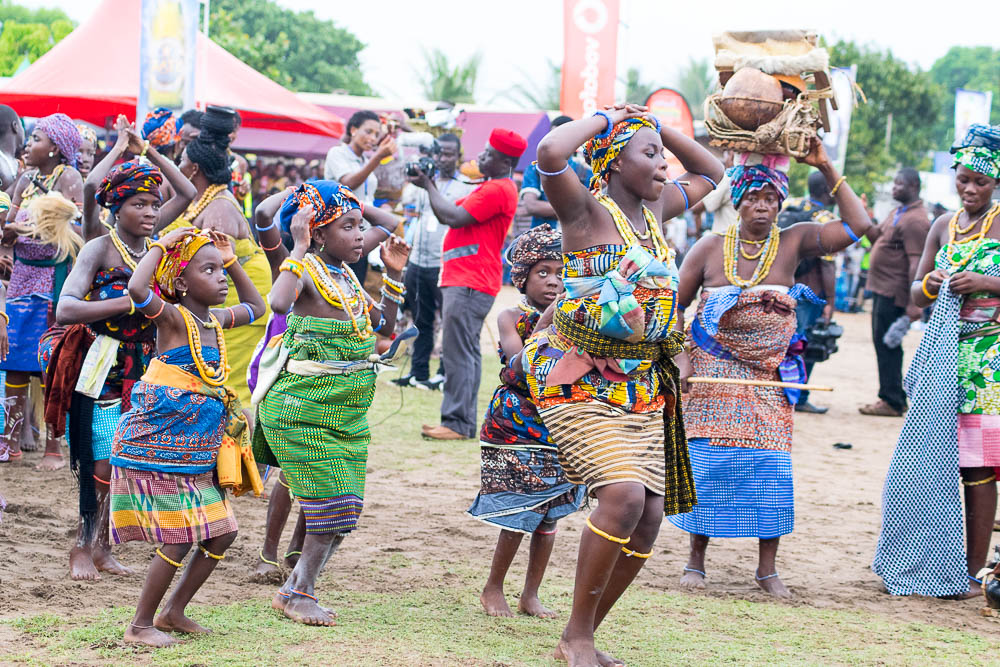
Photo: Traditional dancing by JY Midey, Wikimedia Commons/CC BY-SA 4.0